Posted On
Topics
Research
STEM
Share

For Gwyneth Gagnon ™26, a scholarship did more than ease the cost of college”it made it possible to fully pursue her passion for chemistry.
When she arrived at Emmanuel, Gagnon imagined a future in forensic science. Three years later, she is applying to Ph.D. programs in chemistry, with a résumé that includes extensive research experience, leadership roles, and mentorship of younger students.
She is quick to note that her path has been shaped not only by her own determination, but also by the support she has received along the way. For Gagnon, the Hoye Wallace Lynch Scholarship has provided more than financial relief”it has been a tether, connecting her to a beloved professor whose legacy continues to shape the experiences of Emmanuel students.
The scholarship was established through the generosity of Rose Irma Lynch ™52, who taught at Emmanuel from 1955 until her retirement in 2001. Known for her wit, rigor, and passion for science, Lynch endowed the scholarship in her will to ensure that future generations of students would have the freedom to pursue their own scientific paths.
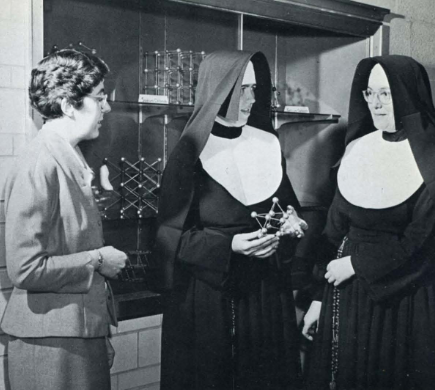
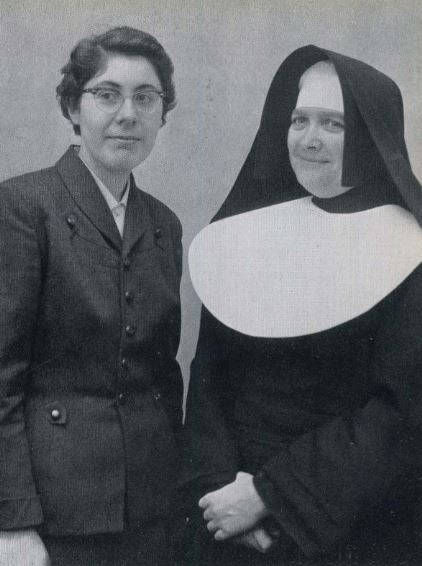
The scholarship was established in 1986 by Emmanuel Alumna Rose Irma Lynch ™52 in honor of Sr. Mary John Hoye, SNDdeN, ™30 and Sr. Magdalen Julie Wallace, SNDdeN, ™35. Both women served as chemistry professors at Emmanuel for over 40 years and were actively involved as Trustees of the College. Lynch endowed the scholarship through her will so that future generations of students could pursue their own scientific paths.
œI don™t think I would have had the same opportunities without this support,� Gwyneth said. œIt not just about covering tuition. It about being able to take risks, to spend more time in the lab, to think seriously about a future in research.�
A Research Journey That Began Freshman Year
A native of Chicopee, Mass., Gagnon began conducting research during her first year at Emmanuel. She joined the lab of former Assistant Professor of Chemistry Juan Duchimaza Heredia, studying carbon dots”tiny, easily synthesized particles that fluoresce under UV light and have promising applications in medicine and forensics. Current methods for tagging tumors or lifting fingerprints often rely on heavy metals; carbon dots, by contrast, are more environmentally friendly.
œThe goal is to understand why they fluoresce,� she said. œIf we can figure that out, we can use them for safer cancer detection or more sustainable forensic techniques.�
The scholarship has also freed her to pursue opportunities beyond Emmanuel. She has conducted summer research at Princeton and at the University of Oregon”her first time on the West Coast”where she collaborated with graduate students and postdoctoral researchers. This fall, she is applying to doctoral programs at institutions including MIT, the University of North Carolina at Chapel Hill, Worcester Polytechnic Institute, and Oregon.
Raised in a close-knit family, Gagnon was drawn to Emmanuel by its intimate scale and the promise of mentorship. œI spoke with students in the labs on my tour, and they told me how much they loved the faculty,� she said. œI saw myself here.�

Mentorship has been a theme throughout her time on campus. œThe chemistry department is small but so supportive,� she said, naming Professor of Chemistry Aren Gerdon, Assistant Professor of Chemistry Nathaneal Lau, and Assistant Professor of Biology Janel Cabrera as instrumental guides.
Beyond the lab, Gagnon taken advantage of the many opportunities Emmanuel offers students to engage with the community, serving as president of EMSTEM, a student group dedicated to supporting underrepresented identities in science, mentoring younger students through the Women in Science program, and serving as a peer mentor. For two years she managed Emmanuel softball team and played for a season herself, before deciding to devote more time to academics and research.
The Hoye Wallace Lynch Scholarship has allowed her to make these choices freely, without the strain of balancing additional jobs. œDoing distinction in the field with this scholarship is like completing a senior thesis, but I also get to design much of the project myself,� she said. œThat unusual at the undergraduate level.�
For Gagnon, the connection to Rose Irma Lynch ™52 feels deeply personal. œTo know that Professor Lynch chose to invest in students like me”that a responsibility I carry,� she said. œI want to live up to that legacy.�